If your RV refrigerator cools normally on propane but not on shore power, the cooling unit is probably not the first thing to blame.
On a two-way absorption refrigerator, propane and 120-volt AC are simply two heat sources for the same cooling system. If propane mode works but electric does not, focus on the AC side: power delivery, the heating element, wiring, or the control board.
Quick diagnosis
| What happens | Most likely area |
|---|---|
| Cools on propane, not electric | AC outlet, breaker/GFCI, heating element, AC wiring, board |
| Cools on electric, not propane | Propane supply, burner, igniter, gas valve |
| Does not cool on either mode | Ventilation, level, thermistor, cooling unit |
| Display is dead | 12V control power, fuse, ground |
The fastest path is: confirm propane cooling → verify 120V at the refrigerator → test the heating element → check the AC control circuit.
Safety first
Absorption refrigerators can involve 120-volt AC power, 12-volt controls, propane, hot boiler components, and an ammonia-based cooling unit.
Stop troubleshooting if you notice an ammonia smell, yellow residue, burned wiring, smoke, or scorching. Those can indicate a cooling-unit or electrical failure.
If testing requires exposed 120-volt wiring or propane components, use a qualified RV technician.
Step 1: Confirm propane mode actually cools
Do not assume propane mode is working just because the burner lights.
Run the refrigerator long enough to confirm the food compartment is actually getting colder. Absorption refrigerators cool slowly, so use a thermometer and look for a downward temperature trend over several hours.
If propane mode cools correctly, that strongly suggests the sealed cooling unit can still perform its job. That makes the electric heat source and its control circuit the main suspects.
Step 2: Verify 120-volt power at the refrigerator
A refrigerator can have a working display and interior light while still having no 120-volt power.
That is because many absorption refrigerators use 12-volt DC for the control board even when cooling on AC.
Check:
- Shore power or generator
- Main RV breaker
- Refrigerator breaker
- Any GFCI feeding the refrigerator circuit
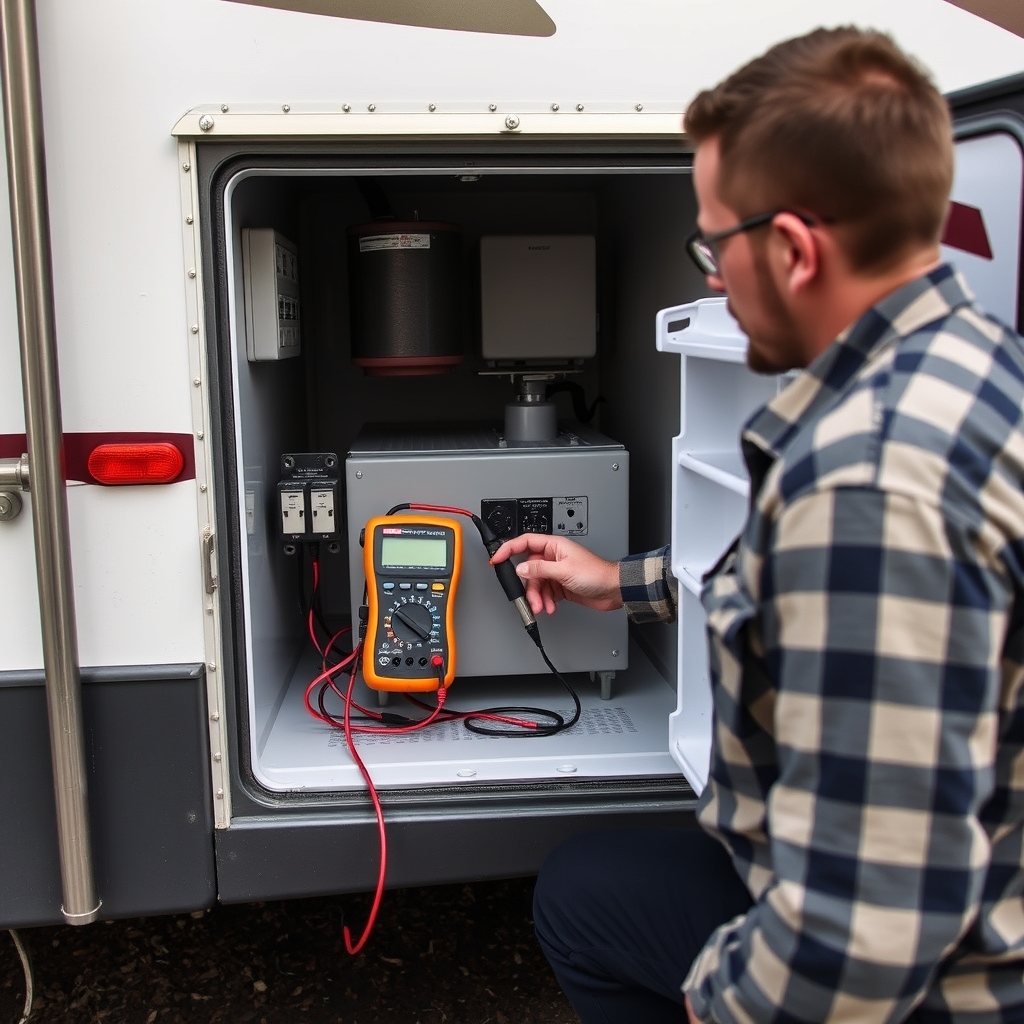
- The refrigerator outlet behind the exterior access panel
Do not assume another working AC appliance proves the refrigerator outlet has power.
If the refrigerator outlet is dead, fix the upstream electrical problem before testing refrigerator parts.
Step 3: Confirm the refrigerator is selecting AC mode
If the refrigerator has AUTO mode, verify that it actually recognizes shore power and selects electric operation.
If 120 volts is present at the outlet but the refrigerator will not enter AC mode, possible causes include:
- AC detection fault
- Blown onboard fuse
- Wiring problem
- Control-board relay failure
- Main control-board fault
Use the fault-code or indicator information for your exact refrigerator model.
Step 4: Test the AC heating element
If the outlet has power and propane mode cools normally, the AC heating element is one of the strongest suspects.
The element is normally installed in the boiler area. Its job is to create the heat that propane provides in gas mode.
A failed element can leave the refrigerator looking completely normal while producing no cooling on electric.
With all power disconnected, test the heating element according to the resistance specification for your exact model.
A heating element that reads open or falls clearly outside the manufacturer's specification is likely failed.
Do not use a resistance value from a different Dometic or Norcold model.
Step 5: Check whether the element receives AC power
A good heating element will not work if the board never sends power to it.
This separates an element failure from a control failure.
If the refrigerator is calling for electric cooling but the element receives no power, investigate:
- Element wiring
- Burned or loose connectors
- Board fuse
- AC relay
- Control board
If correct voltage reaches the element but it does not heat, the element is the stronger suspect.
Testing live 120-volt circuits should be left to someone qualified if you are not trained to do it safely.
Step 6: Check 12-volt control power
Even in electric mode, many absorption refrigerators still need stable 12-volt DC power for the control board.
Check the refrigerator's DC fuse, battery voltage, grounds, and board connections.
A weak battery or charging-system problem can cause strange refrigerator behavior even when shore power is connected.
If your RV is also showing battery-charging problems, diagnose that system separately before replacing refrigerator electronics.
Step 7: Inspect wiring and connectors
The boiler area gets hot, so element wiring and connectors can deteriorate over time.
With power disconnected, inspect for:
- Burned terminals
- Heat discoloration
- Brittle insulation
- Loose spade connectors
- Corrosion
- Broken wires
A damaged connection can create exactly the same symptom as a failed heating element.
Do not simply reconnect a visibly burned terminal and keep using it.
Step 8: Suspect the control board last
The control board should not be the first replacement.
It becomes a stronger suspect only after you have confirmed:
- The refrigerator outlet has 120-volt power
- 12-volt control power is stable
- The heating element tests correctly
- Element wiring is intact
- AC mode is being requested
If all of those check out but the board does not energize the heating circuit, the board or its AC relay may be faulty.
What if propane does not cool either?
If neither propane nor electric mode cools, the problem is broader than the AC circuit.
Then check:
- Rear ventilation
- RV level
- Thermistor operation
- Cooling-unit condition
- Door seals
- Internal airflow
- Ambient temperature
An absorption refrigerator needs good airflow behind the unit. Blocked exterior vents or poor heat removal can reduce cooling on both energy sources.
If you smell ammonia or see yellow residue near the cooling unit, shut the refrigerator down and have it inspected.
Give the refrigerator enough time
Absorption refrigerators do not cool as quickly as compressor refrigerators.
After switching modes or starting from warm, give the refrigerator several hours and verify temperatures with a thermometer.
Do not replace parts because the cabinet does not feel cold after only a short test.
Troubleshooting order
Use this sequence:
- Confirm you have an absorption refrigerator.
- Confirm propane mode truly cools.
- Check the refrigerator breaker and GFCI.
- Verify 120 volts at the refrigerator outlet.
- Confirm AC mode is selected.
- Check stable 12-volt control power.
- Test the AC heating element.
- Check element wiring and connectors.
- Verify whether the board is supplying the element.
- Suspect the control board only after the other checks pass.
Frequently asked questions
Quick answers to the questions RV owners usually ask after working through this guide.
01 Why does my RV refrigerator work on propane but not electric?
The problem is usually isolated to the electric heat source or its power circuit. Check the refrigerator outlet, breaker/GFCI, heating element, wiring, and the board's AC switching circuit.
02 Can the refrigerator display work even if AC cooling does not?
Yes. The display and control board may use 12-volt DC power while the heating element requires 120-volt AC.
03 How do I know if the heating element is bad?
First verify the refrigerator has AC power. Then disconnect power and test the element using the manufacturer's resistance specification for your exact model.
04 Is the cooling unit bad if propane mode works?
Usually not. If propane mode actually produces normal cooling, the shared absorption cooling unit is still capable of working.
05 How long should I test electric mode?
Give an absorption refrigerator several hours and monitor it with a thermometer. Judge the temperature trend rather than expecting rapid cooling.
Bottom line
If your RV refrigerator works on propane but not electric, keep the diagnosis focused.
Verify the refrigerator's AC outlet, breaker/GFCI, 12-volt control power, heating element, wiring, and board switching circuit.
A working propane mode is evidence that the refrigerator can still cool. Use that clue to isolate the electric side instead of expanding the diagnosis into every possible refrigerator failure.
This guide is educational. Stop and use a qualified RV technician when a procedure involves unsafe electrical, propane, structural or pressurized-system work beyond your experience.