If your RV water heater is not working, first identify what kind of failure you have. A unit that does nothing has a different problem from one that clicks but will not ignite, and both are different from a heater that runs but only produces lukewarm water.
| Symptom | Most likely areas |
|---|---|
| Nothing happens | 12V power, fuse, switch, control board |
| Clicks but will not ignite | Propane supply, burner tube, igniter, gas valve |
| Works on propane but not electric | 120V breaker, switch, element, thermostat/ECO |
| Works on electric but not propane | LP supply, ignition circuit, burner, gas valve |
| Burner lights then shuts off | Flame sense, electrode, ground |
| Water is lukewarm | Bypass valve, plumbing crossover |
| No hot-water flow | Bypass/check valve, restriction |
The fastest diagnosis comes from comparing what works with what does not.
Safety first
RV water heaters can involve propane, 12-volt controls, 120-volt AC power, hot water, and combustion exhaust.
If you smell propane, suspect a gas leak, find burned wiring, or need to test exposed 120-volt circuits or gas pressure, use a qualified RV technician.
For tank-style electric water heaters, never energize the heating element unless the tank is full of water.
Step 1: Identify the water-heater type
This guide applies mainly to traditional RV tank water heaters, including common propane/electric models.
If you have a tankless unit, start with the displayed fault code and the manufacturer’s manual because the diagnostic process is different.
Find the model number before testing components.
Step 2: Check bypass and winterization valves
If the RV was winterized, the heater may still be bypassed.
An incorrect valve position can cause:
- No hot water
- Lukewarm water
- Cold water mixing into the hot line
For normal use, the cold inlet and hot outlet usually need to be open while the bypass line is closed.
Exact plumbing varies, so use the RV or water-heater diagram for your model.
If the burner is clearly heating the tank but the faucets are still lukewarm, check the bypass before replacing heating components.
Step 3: If nothing happens, check 12V power
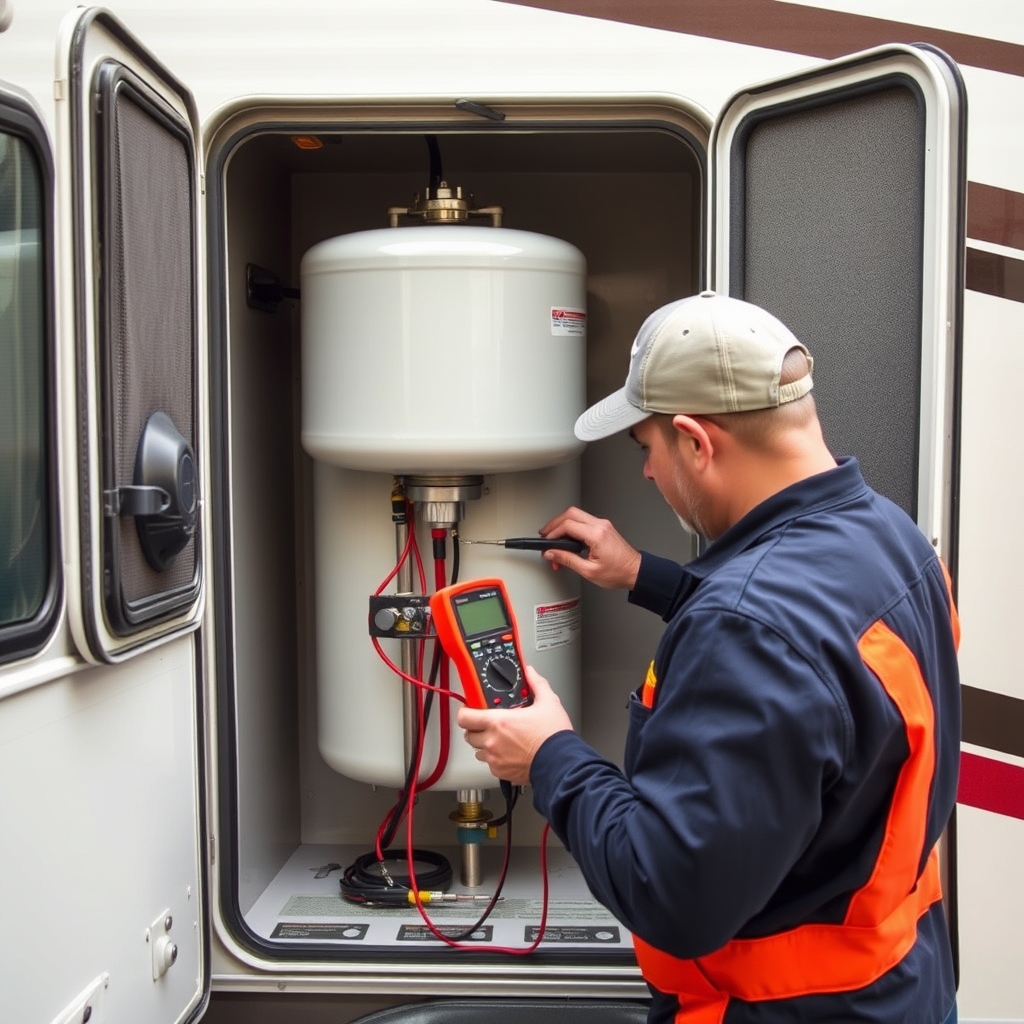
Most propane RV water heaters still need 12-volt DC power for the control board, gas valve, and ignition.
Check:
- House-battery voltage
- Water-heater 12V fuse
- Interior switch
- Local service switch, if equipped
- Ground and accessible connectors
If battery voltage is very low, the control board may not complete the ignition sequence.
Do not start with the gas valve or control board until basic 12V power is confirmed.
Step 4: If it clicks but will not ignite
Repeated clicking usually means the ignition system is trying to light the burner.
Now focus on propane delivery and the burner area.
Check propane supply
Confirm:
- Tank has fuel
- Service valve is open
- Other propane appliances work
If other propane appliances are weak or also failing, the water heater may not be the root problem.
Inspect the burner tube
With the heater and propane supply turned off, inspect the accessible burner area for:
- Spider webs
- Mud-dauber nests
- Rust flakes
- Dirt
- Insect debris
A blocked burner tube can prevent the correct fuel-air mixture even when the igniter is sparking.
Do not enlarge gas orifices or insert objects into calibrated openings.
Step 5: Inspect the igniter electrode
If propane is available and the burner path is clear, inspect the igniter.
Look for:
- Cracked ceramic
- Corrosion
- Loose connection
- Damaged ignition wire
- Incorrect electrode position
A visible spark does not prove it is occurring in the correct place.
Use the manufacturer’s specification for electrode position and gap.
Step 6: If the burner lights then shuts off
If the burner ignites briefly and then drops out, the system may be failing to confirm flame.
Possible causes include:
- Dirty electrode
- Poor ground
- Damaged ignition/flame-sense wire
- Incorrect electrode position
- Control-board fault
Many RV water heaters use the ignition electrode as part of the flame-sensing circuit.
A poor ground can cause an intermittent flame-sense problem that looks like a bad control board.
Step 7: If propane works but electric does not
If the heater works normally on propane but not on electric, stay on the 120-volt side.
Check:
- Shore power
- Water-heater circuit breaker
- Electric-mode switch
- Heating element
- Thermostat/ECO circuit
- Wiring
Some models also have an exterior electric switch that is easy to miss.
If breakers and switches are correct but the water does not heat, the element or its control circuit may need testing.
Exposed 120-volt work should be handled by someone qualified.
Step 8: If electric works but propane does not
If electric mode works normally, the tank and basic plumbing are probably not the main issue.
Focus on:
- Propane supply
- Igniter
- Burner tube
- Gas valve
- 12V control power
- Ground
- Control board
This propane-versus-electric comparison is one of the fastest ways to narrow the problem.
Step 9: Check thermostat/ECO reset only when appropriate
Many tank water heaters use a thermostat plus an ECO, or high-temperature safety device.
Some models have reset buttons behind the exterior access panel.
If the ECO has tripped, the heater may stop operating.
Do not keep resetting a safety device that repeatedly trips. Repeated tripping means the cause still needs diagnosis.
Step 10: If the water is only lukewarm
Lukewarm water is often a plumbing issue rather than a heating failure.
Check:
- Water-heater bypass valve
- Outside shower valves
- Plumbing crossover
- Check valve
- Mixing point
A common RV problem is an outside shower with both hot and cold valves left open while flow is stopped only at the shower head. That can allow cold water to mix into the hot-water line.
Close both faucet valves fully and retest.
Step 11: If there is little or no hot-water flow
If cold water flows normally but the hot side has weak or no flow, think plumbing first.
Possible causes include:
- Incorrect bypass-valve position
- Failed check valve
- Scale or debris
- Plumbing restriction
- Frozen line
For tankless models, low flow can also prevent burner activation, so check the model-specific fault code and inlet filter.
When should you stop troubleshooting?
Use a qualified RV technician if:
- You smell propane
- A gas leak is suspected
- Gas pressure needs testing
- A gas valve needs diagnosis
- Exposed 120V wiring must be tested
- Wiring is burned or melted
- The ECO repeatedly trips
- Combustion is unstable
Do not bypass thermostats, ECOs, flame-sense circuits, or gas-safety devices.
Troubleshooting order
Use this sequence:
- Identify the heater type.
- Check bypass/winterization valves.
- Confirm 12V power.
- Check the fuse and switches.
- If using propane, confirm LP supply.
- Listen for ignition clicks.
- Inspect burner tube and igniter.
- If it lights then stops, check flame sensing and grounds.
- If electric mode fails, check breaker, switch, element, and controls.
- If water is lukewarm, check for plumbing crossover.
Frequently asked questions
Quick answers to the questions RV owners usually ask after working through this guide.
01 Why does my RV water heater click but not ignite?
The ignition system is trying to light the burner. Check propane supply, burner-tube blockage, igniter condition, gas-valve operation, and 12V power.
02 Why does it work on propane but not electric?
The fault is probably on the 120V side. Check shore power, the breaker, electric-mode switch, heating element, thermostat/ECO circuit, and wiring.
03 Why is my RV water only lukewarm?
Check the bypass valve and plumbing crossover first. An outside shower with both valves open can mix cold water into the hot-water line.
04 Can low battery voltage stop a propane water heater from working?
Yes. Many propane water heaters still require 12V power for the control board, igniter, and gas valve.
Bottom line
Use the symptom to narrow the system.
No response points toward power, fuses, and controls. Clicking without ignition points toward propane delivery, the burner, and igniter. Propane-only or electric-only failures isolate one side of the heater. Lukewarm water often points to bypass or crossover plumbing.
That approach is faster than treating every water-heater problem as a complete system failure.
This guide is educational. Stop and use a qualified RV technician when a procedure involves unsafe electrical, propane, structural or pressurized-system work beyond your experience.